Friday, December 24, 2010

Overheard: Conversation With My Nephews

Cast: Elaine (my sister), David (my brother), Dace and Dover (my nephews)

Dover: "Aunt E, how come you are not married?"

Elaine: "Baby, no one has asked me to marry them yet."

Dace: "Why don't you marry Uncle David?"

Elaine: "I can't marry Uncle David because he is my brother."

Dace: shaking his head, "That stupid law."

Thursday, December 16, 2010

Making Wrong Decisions

Moving from individual contributor (IC) to taking on management responsibility I have observed two important (and probably obvious) facts. First, a manager ends up making a lot more incorrect decisions then a IC; Second, (and perhaps most obviously) those decisions effect more people. So how do you cope when you make a wrong decision?

I've found the hardest part for me is dealing with different reactions when things go wrong. My first reaction is to start fixing right away. My idea of taking responsibility is to try to resolve the issue if possible and start damage control if it isn't. The error here is that I didn't stop long enough to think about how the team will react.

Here is an example: working on a (hypothetical) project with delivery date for a software module. Discussing it with the team, one member is concerned about the risk of meeting the delivery date and proposes an alternate date. After some back and forth I make a judgement call and decide that it is worth taking the risk since getting the module out early will lower cost. Half way in, it is clear that my judgement was wrong. Now the team member is very upset. Not only was he proven right about the risk, now he is going to be asked (by his jerk manager me!) to work harder / stay extra to try to finish the module within the required deadline.

Putting the poor guy (or gal) at ease has to start with eating crow. I think the idea here is to communicate that the mistake was mine and that I'm going to try to fix it. I think it is important to say it (provided I think it was my mistake). I have to admit though I don't know exactly the best way to do this.

Let's reverse the situation and say that it was the team member that made the case for the risky decision that turned out to be wrong. In that case, I think it is important to take responsibility for decisions you approved. Identify if the team member made an error of knowledge or a breach of judgement. Sometimes information was wrong or not clearly understood.

I know I have more questions than answers at this point so I'll turn to you. What are your strategies for dealing with wrong decisions?

Sunday, December 5, 2010

SmartSleep and Secure Virtual Memory

I used SmartSleep for a long time to control my MacBook Pro's sleeping habits. I've finally discovered that this utility doesn't work with Secure Virtual Memory. First, some background.

There are essentially 2 ways a Mac can sleep. The first is 'regular sleep', or for you Windows users, suspend. In this mode the computer saves power by shutting down peripheral hardware (like the disks, screen and keyboard light) while keeping the processor in a low power state. The battery is used to keep the RAM powered so that when you resume (ie. open the lid) the computer can turn everything back on and start right back where it left off.

The second is called 'safe sleep'. This is like hibernate mode for Windows users. In this mode the computer RAM and processor state is written out to disk and the computer is turned off. Obviously this is very power efficient (off == good for battery life!). The problem with this mode is that when you want to use the computer you have to wait a LONG time for the resume process to complete. On my machine I have 8 GB of RAM (on a laptop - how far we've come!). It takes almost 2 minutes to resume my machine in safe sleep.

SmartSleep is supposed to let you control and choose these modes. There is also a hybrid mode that will suspend AND hibernate, but only power down the machine if the battery goes too low. If the battery is removed or dies, you can then resume like you did from a hibernate. It takes a long time but it works and you loose no data. In the best case it resumes quickly because the state of the processor/RAM was preserved by the battery power.

Now enters Secure Virtual Memory. I use this setting because I don't want data like key material and passwords leaking into my swap file. It has almost no impact on performance and in the case that my laptop is stolen or captured at the border it will protect my privacy rights. You can turn on Secure Virtual Memory in the Security System Preferences Pane.

SmartSleep doesn't take the Secure Virtual Memory setting into account. This means that if you have it turned on it sets the hibernatemode option incorrectly. When my machine goes into safe-sleep, it can't recover and I'm forced to reboot (and loose data!). Here is the settings that should be used:

The hibernatemode option in power management settings selects the suspend policy:
$ sudo pmset -a hibernatemode 0
always regular sleep (disable safe-sleep)
$ sudo pmset -a hibernatemode 1
always safe-sleep (disable regular sleep)
$ sudo pmset -a hibernatemode 3
regular sleep first, safe-sleep if the battery is very low on power or is unplugged
$ sudo pmset -a hibernatemode 5
always safe-sleep with secure virtual memory
$ sudo pmset -a hibernatemode 7
regular sleep first then safe-sleep with secure virtual memory
To find out what setting you are currently just type:
pmset -g | grep hibernatemode

I've uninstalled SmartSleep for now and will send this feedback to the author to see if it can be fixed.

Wednesday, November 24, 2010

Jenga pistol


This looks like tuns of fun! HT Michael Balint for pointing it out.

The Looming Credit Disaster

I took Scott Powell's "Crash Course on the Coming Crash" and I have to say I recommend it highly. I didn't get to participate much in the class due to technological issues (I was at my parents' house in Michigan and had company drop in WHILE I was taking the course). The first result of this course was to send an email to my financial planner and sell my sizable municipal bond holding. I've made a pretty good tax free profit on it so far. The risk, unfortunately, is much higher then I was led to believe. Nick, my planner, is in complete agreement about getting out of the market. His reasons include the cash being infused in the QE2 plan by the Fed. I'm not sure when the bubble will burst so it is time to leave now.

The question I'm trying to figure out next is what to do with the cash. Keeping it as cash is a bad idea (especially dollars). Gold is for retaining value and is expensive now (though could go much higher). I would rather invest it somewhere. I just started "Crash Proof 2.0" so maybe I'll find some advice in there.

Wednesday, November 10, 2010

Break Your Heart

I know some of you who listen to the radio this song might be really annoying. Since I don't listen to the radio and haven't been overexposed to it (or even heard the real version to my knowledge), I really enjoy this cover of "Break Your Heart".

Sunday, July 18, 2010

iPhone4 Hatred

There is a lot of iPhone 4 hatred out there. Apple has recently come under a lot of fire for antenna performance, lack of so called 4G (actually 3.9G LTE). Let's examine the first criticism objectively in this post and I'll address the others in upcoming posts. First a comedic interlude. 


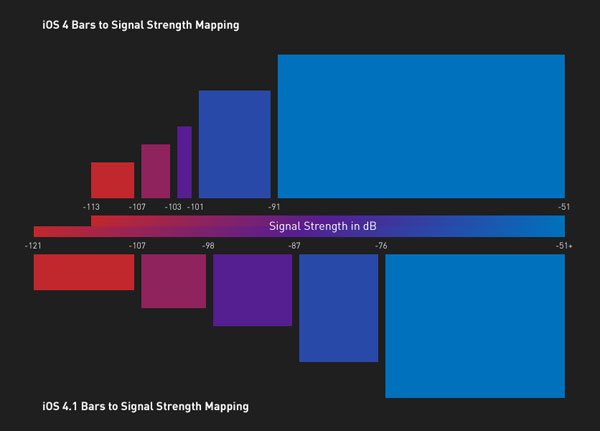
So what is really going on with these antenna issues? Consumer Reports rated the new iPhone 4 as the top smart phone it has ever tested, only to not recommend it due to the antenna issues. I keep saying issues because it can be broken down into two parts. First, the way iOS4 reported signal strength gave people a false sense that signal was stronger then it really was. Anandtec has a great illustration of the difference between what iOS reported in 4.0 to 4.0.1. 
As you can see the middle range was very compressed. The new way will tell people just how crappy we all know the 3G GSM network is that AT&T provides. For those of you Android fans, I suggest you check the link out and see what Droid reports. iOS4 now reports the least compressed bar range out of any smartphone.

The second issue is hand placement. This generated a lot of play in the press and is a real problem for some users. If you place your hand on a certain spot, you can drop your phone performance considerably. Anandtec discusses it in the above article and Apple has posted about their testing. Compared to other phones, Apple made a different design decision -- they opted for good performance in low signal situations. Considering the fact that they are on AT&T's network this is probably a wise choice. A case and better hand placement can reduce the impact of that giant attenuator known as the human body. I usually use my bluetooth anyway (I'm one of those that only seem to call while driving or walking through the city) so I've not been as impacted as others.

Other phone manufactures have responded with weasel words, but have not challenged any of the findings published on Apples website. Apple has offered free cases to iPhone purchasers, Details on how to order a free Bumper or case will be available soon on apple.com.


Saturday, June 26, 2010

Objectivist Roundup

Trey Givens has the honor of hosting 154th Objectivist Roundup go check it out!

Delegation

Those of you who follow me on twitter or facebook know that in the last 6 months I've was put in a more managerial position and in the last few weeks was promoted. My work is a little weird with the positions disconnected from your level so it is confusing. The point is that I'm getting paid more and more is expected of me now. The team I lead is suffering from success. We were so good at doing are job that now we can't stop doing it! Not even to teach new people to our team how to do the job. Basically everyone is swamped. Sound familiar?

One of the hard things that I've had to start doing is sticking my neck out to prioritize things. This is pretty scary since I could end up telling someone not to do something that I find out later was A #1 PRIORITY OMG! Fortunately everything is priority 1 my manager is flexible with prioritization. I'm trying to plot out a course of where we will be in 6 months and figure out team goals for individual development, team development and tool development. If only I could find the time!

The problem is I'm used to being a DOER. When someone comes to me with a problem or task I immediately think -- is this something I am capable of doing? Often that is about as far as I think before I start getting caught up in the planing and doing of the task at hand. I'm trying to catch myself now before I commit to anything and think about a few other questions:

  1. Is this something important to our team goals? Is it something that the customer needs but is better done by someone else?
  2. How important is this? What are the deadlines and how hard are they?
  3. Can it be broken into pieces? Who else on my team is capable of taking on part or all of those pieces?

This leads me to the last thing I've noticed -- I need to delegate more. There is too much to do and not enough time for me to do it all! Besides I have this awesome group of people who can do my bidding! If I can learn to set priorities and pass the right things off to the right people things will improve and people will feel that while there is still more to be done then time to do, they can know that what they have done was important and is taking the team in the right direction.

Tuesday, May 18, 2010

Mohammed

The Objective Standard is hosting a "Drawings in Defense of Life" drive to participate in  “Everybody Draw Mohammed Day,” which is May 20. Here is my submission.


OLists


I've been a member of OEvolve, OShooting and OProducers and have enjoyed the steady stream of useful information. Diana has selected terrific moderators to keep the lists on topic. I hope to join OActivists and Obloggers soon as well! Please take a look and see if you'd be interested in any of the topics. You don't have to be an Objectivist to lurk on many of the lists.

Wm

Hi, I’m  Diana Hsieh.  I’m an Objectivist and a recent Ph.D in philosophy.
I oversee an independent network of e-mail lists for friendly discussion and information-sharing among advocates of Ayn Rand’s philosophy of Objectivism.  They are the “OLists” : http://www.OList.com
The common goal of the OLists is to serve the real-life values and interests common to subscribers — such as activism, blogging, parenting, health, productivity, firearms, gardening, and academia.  These lists have been active, informative, and useful to their hundreds of subscribers; they’ve helped connect Objectivists with values in common.  In case you’ve not heard of them, I invite you to see whether they might foster your values too.
Please note that these lists are not free-for-all discussion lists.  Each list has a clear purpose, as well as definite membership criteria.  Also, some lists are limited to Objectivists, while others welcome non-Objectivist lurkers.  Please check the list’s purpose and membership criteria before you request a subscription.
Without further ado, the OList e-mail lists are…
OActivists is an e-mail list for Objectivists committed to fostering positive cultural and political change.  Its purpose is to encourage and assist effective advocacy of Objectivist ideas in non-Objectivist forums by facilitating communication between Objectivist activists.  Membership is limited to Objectivist activists.  It is managed by Tammy Perkins.
OBloggers is an e-mail list for Objectivist bloggers.  Its purpose is to facilitate communication about matters of mutual interest, such as upcoming events, blogworthy links, posts of interest, blog promotion, and best blogging practices.  Membership is limited to Objectivist bloggers.  It is managed by Kate Gerber of CareerMama (http://www.careermama.com).
OGrownups is an informal e-mail list for for Objectivists and others interested in raising and educating children well. Its basic purpose is to facilitate discussion amongst Objectivists about child development, discipline techniques, education methods, parenting resources, and more.  Non-Objectivist lurkers are welcome.  It is managed by Jenn Casey of Rational Jenn (http://rationaljenn.blogspot.com).
OEvolve is an informal e-mail list for Objectivists and others interested in the proper application of evolutionary principles to diet, fitness, and health.  Its basic purpose is to facilitate discussion and information-sharing amongst Objectivists about the practical sciences of cooking, nutrition, fitness, health, and more.  Non-Objectivist lurkers are welcome.  It is managed by Monica Hughes of Ancestral Generation (http://ancestralgeneration.com).
OProducers is an e-mail list for Objectivists and others committed to improving their habits of productivity in their careers, projects, and other pursuits.  Its purpose is to facilitate discussion and information-sharing amongst Objectivists about practical methods for better management of time, projects, money, people, and other resources.  Non-Objectivist lurkers are welcome.  It is managed by Tod of Optimal Living (http://blog.bytod.com).
OShooters is an e-mail list for Objectivists and others enthused about firearms and committed to gun rights.  Its basic purpose is to facilitate discussion and information-sharing amongst Objectivists about firearm models, shooting techniques, gun ranges, gun laws, and the like.  Non-Objectivist lurkers are welcome.  It is managed by Santiago Valenzuela.
OGardeners is an informal e-mail list for Objectivists and others interested in gardening and landscaping.  Its purpose is to facilitate discussion and information-sharing amongst Objectivists about the cultivation of flowers, vegetables, shrubs, and trees.   Non-Objectivist lurkers are welcome.  It is managed by Kelly Elmore of Reepicheep’s Coracle (http://reepicheepscoracle.blogspot.com).
OAcademics is an e-mail list for Objectivist academics to discuss teaching, research, coursework, dissertations, job prospects, publication, and all other aspects of life in (or after) academia.  Membership is limited to Objectivist academics.  It is managed by Diana Hsieh of NoodleFood (http://blog.dianahsieh.com).
If you have any questions or comments about the OLists, please feel free to e-mail me at diana@dianahsieh.com.
– DMH
Diana Hsieh (Ph.D, Philosophy, CU Boulder)
E-mail: diana@dianahsieh.com
NoodleFood: http://www.dianahsieh.com/blog
NoodleCast: http://www.dianahsieh.com/cast
ModernPaleo: http://www.ModernPaleo.com/
Twitter: http://twitter.com/DianaHsieh

Friday, April 16, 2010

Comcast Update

A big Thank You! to someone over at Comcast Corporate. They managed to restore one of my cable cards! The Tivo is now operating at half capacity until Sunday when a new cable card can be delivered by the repair guy. I only hope they bring a cable card...

Thursday, April 15, 2010

Comcast Help

I am always frightened when I have to call Comcast to update my cable service. Every time I call to change my lineup the following events happen:

1. The account is coded wrong and I end up getting bumped out of my promotion, and my next bill is much higher then it should be. To counter this I always call 2 days later and confirm the price I should get.

2. One (or both) of my Tivo cable cards get 'zapped'. For unknown reasons Comcast looses all the details of my cable cards causing me to have to call them on the phone. This call helps fix the problem 2 of the 5 times this has happened.

3. The support call listed in 2 causes the other cable card information to disappear from Comcast's system. Now I have a Tivo that can only see local stations. The poor support folks can't get their computers to take the magic numbers in order to give me service. I schedule a tech, they come out, swap cards about 5 times until the one person in the NOC who knows what they are doing gets my card information into the system. 3 of the 4 times I've had this happen it has involved multiple techs because the cards 'don't work'.

If you are that one person in the NOC who knows what they are doing, here is my information that you need to make this happen:

Tivo Series 3 (2 single stream cards required)


Account number 09518405122023

Motorola MediaCipher M-CARD
Card1 S/N MA0817CABVX5
CableCard ID 000-008-174-088-8
Host ID: 035-011-305-285-5
Data: 361-764-662-86

Card2 S/N MA0817CAAOZ4 (note that last is a letter O afaik)
CableCard ID 000-008-174-074-8
Host ID: 035-011-305-284-8
Data: 251-674-807-37

Tuesday, April 13, 2010

Response to "Total Money Makeover"

Dave Ramsey is one of the largest money talk franchises on radio with more than 4.5 million weekly listeners on 400-plus affiliates.  He has written several books, including “The Total Money Makeover - A Proven Plan for Financial Fitness”, where he outlines his philosophy on personal finance and the steps for building personal wealth.

Ramsey has a strong opinion on debt -- he sees debt as dangerous to your financial health. “Debt brings on enough risk to offset any advantage that could be gained through leverage of debt.” (Pg 21) The only debt he tolerates, and only grudgingly, is a 15 year mortgage, and only if you are paying over the payment due every month. Ramsey himself felt he was victimized by debt when he went from a rich 26 year old to bankruptcy within a few years. He says that his views on debt were codified after this experience.

The first five chapters are completely infected with Ramsey’s anti-debt bias -- any debt is bad debt. These chapters focus more on psychological motivation then sound financial arguments. He argues that there are five hurdles that someone must overcome in order to makeover their financial situation. Denial, debt myths, money myths, ignorance and keeping up with the Joneses. Evading reality and holding onto wrong ideas about money, debt and happiness lead people to make bad financial choices.

Ramsey is correct to call for people to make an objective assessment of their financial situation. Many people evade that they have a problem, spending money and taking on debt they can not afford while raising their risk of insolvency. People don’t want to think about the possibility of disaster or set goals necessary for financial success. Spending as much as you are brining in is not a long term strategy for reaching financial goal. Growth, on the other hand, is the sign of financial health. I think Ramsey hits very close to the mark on this section since most people do not integrate their personal goals (or even take time to identify them) with their financial goals to the depth required to implement them. This is part of the reason I talk with my financial planner at least once a year to make sure I have an independent objective and expert assessment.

Ramsey’s book is basically a self-help book full of infomercial style testimonials and bible versus. His style is almost that of a preacher arguing with his congregation to repent for the sin of debt. His advice is very basic, though much of it is sound and needed by people struggling for financial health.
Despite giving some sound advice there are problems with Ramsey’s arguments. First is his reliance on testimonials as evidence for the success of his financial plan. While a few anecdotes could be useful, there are so many that you loose track of what the lesson is from the stories. Going more in depth with at most 1 or 2 stories per chapter, showing the numbers in spreadsheet style would have been a more effective way to demonstrate effectiveness even to a laymen. People can only hold so many examples in their mind when learning new concepts and strategies.

The problems don’t stop at the testimonials -- he attempts to argue by appeals to religion. I understand that religion may be important to some, but Proverbs 22:7, “The rich rules over the poor, and the borrower is servant to the lender” (NKJV) is not an argument. Arguments are made with appeals to reality and logic, in the case of personal finance, this has to involve numbers and not verses. Implicit in the verse he selects is that creditors and people who go into debt are immoral. This is a grave mistake from someone who presents himself as a financial expert.

Credit is just money -- unconsumed goods -- loaned by one productive person (or a group of them) to another. Interest (in a free market, which is not what we enjoy today) represents the costs of consuming those goods now versus using them for some other purpose. Interest also factors in the risk associated with the person who is receiving the loan. If the loan is not repaid by default, then the goods that money represented, the saved productivity, is consumed without a productive return. The investor loses his money. If the venture succeeds, the producer pays the interest out of the profits which he was able to earn through the productive use of the loan. Debt then is a tool when viewed from this perspective: a way to leverage productivity. What works for a corporation works the same for an individual. A company using loans to meet payroll is in serious trouble. A man using credit for food, rent, and other consumption items is in the same kind of trouble. This is why loans are good for houses (and even cars, provided you use it for productive purposes and measure your choice on how well it gets you to work). This is the kind of argument the author could have replaced the bible versus with that would be more compelling and in line with his recommendations.

A third issue with his arguments represent the method he used to identify them -- an epistemological error. First presented here in the book, but often repeated, is variations of this:
I have found that if you look into the lives of the kind of people you want to be like, you will find common themes. If you want to be skinny, study skinny people, and if you want to be rich, do what lots of rich people do, not what some mythsayer (sic) says to do.
To understand the error in this kind of argument I’m going to use an example I first heard from Dr. Doug McGuff and John Little in their book “Body By Science”. People look at champion swimmers and bodybuilders and want to change their body composition to match theirs. The way many people think leads them to conclude if they want to look like Michael Phelps, they should train and eat like he does. If they would like to look like Arnold Schwarzenegger, they should do what he did preparing for the Mr. Universe competition. After all, all the swimmers in the olympic finals all have the same body type, as do all the competitors in a body building competition. The error lies in the conclusion that the cause of the swimmer body type is their training and diet.. To put the hypothesis that swimming causes a swimmers body you can simply visit a national AAU swim meet. At the start of the meet you will see competitors with all different body types during the initial qualifiers. Over the course of the day, this variety changes dramatically, becoming less and less diverse, until in the finals almost all the swimmers have the same body type. The reason is a self-selection process, the swimmer’s body type is the best for swimming. What you are observing is an accelerated evolution at work. The erroneous conclusion that swimming causes the body type is reversing cause and effect -- the body type is what enables exemplary performance at swimming. So when using observational statistics it is important to keep the entire context and not assume a cause-effect relationship from a correlation.

Looking at rich people and seeing that they have little or no debt is interesting but does not demonstrate a causal relationship. As with the swimmers, the cause/effect relationship could be reversed. Perhaps the fact that they were able to earn money productively early on caused them to stay out of debt. It could be that the two things are totally unrelated when business credit and personal credit are combined for a given individual. Perhaps the virtues or values of productive people (ie. their productivity, creativity, integrity, etc.) are the cause of both their financial success and their lack of debt. Observational statistics can help find patterns and lead to inductive theories that must be tested by holding the whole context of the situation avoiding the pitfall of assumed cause and effect.

The second half of the book discusses Ramsey’s seven “baby steps” to financial makeover. Each step on it’s own I for the most part agree with him, especially his retirement advice and savings advice. His concept of a debt snowball is a good strategy for people trying to pay off debts quickly.
Start an emergency fund of $1,000.
Pay off all debt fast using the “debt snowball” method (except mortgage).
Build emergency fund to cover 3-6 months of expenses.
Invest 15% of household income into Roth IRAs and other pre-tax retirement accounts.
Save for your child’s college fund
Pay off home early
Build wealth and give! (Mutual Funds & Real Estate)
His wealth building advice is much shakier then his debt reduction strategy. He talks about investing in real estate and mutual funds. Most mutual funds do not beet the S&P 500 index over the long term so selecting the right mutual fund is crucial and understanding the risks and alternative are key to making that kind of investment decision. Real estate is also risky, as demonstrated by the recent credit bubble puffing up the market which is now in the process of correcting for over-investment through lowering prices. Many people have put more cash into their houses then they could now get on the open market for much of the foreseeable future.

Overall, I would not recommend the book. His strategies for debt reduction are implementable and can be found all over his website and radio show. For all the advice Ramsey gives about avoiding debt there is an awful lot of expensive training materials, books and seminars offered at the end of the book. People would be better off spending that money on reducing their debt and listening to his free radio show for the motivation, or better yet, picking up another book that can show you how to get the numbers. Sites like Mint.com can help people see exactly where their money is going which can be very motivational in addressing budget, debt and investment priorities objectively. Ramsey’s training material, books and seminars appear to be an expensive way to motivate yourself to financial health.

Monday, February 15, 2010

Technological Innovation: The Road to Prosperity

My first assignment in my Technical Innovation class I was tasked with a 'concept diagram' with my view on the importance of technical innovation. I wasn't the only one to take a more philosophic bend on the task though I was the only one who quoted Rand :-)

slide with quotes

Technological innovation is bringing something new into existence combining knowledge gained from scientific study to solve practical problems. It is different from traditional engineering practice, since there the principles are known and while creativity and problem-solving are required they are in the application of existing and tested principles. When an architect builds a building out of steel and concrete he can lean on all of the knowledge about existing structures and their performance to aid him in his design. He also has an established business market to sell his building in. When Bell invented the telephone, he had neither. The engineering principles (and some of the scientific ones) had to be discovered and the market needed to be created. If the Wright brothers had chose to publish a paper on wing warping after their discovery of that aerodynamic process in their bike garage it would have been a great scientific accomplishment. Taking it all the way to the 1903 Wright Flyer made it a technical innovation. Clearly there is an extra step taken after the laws of nature are discovered by science before they are of practical use to man.

So why is technical innovation important? Technology innovation is the creation of new applications of scientific discoveries to productive problems of man. It is how we get from the discovery of radio waves to iPhones and from the steam engine (known as far back as ancient Greece) to the modern jet engine. Man's ability to be more productive (and live better, more flourishing life) is bounded only by the creativity and ability of the people who innovate. This is why it is important: it makes YOUR life better.

Most of the rest of the class focused on the military and cultural superiority that comes from leading technical innovation. I wanted to bring in especially Rand's quote that technology is the implicit and ultimate purpose of man's pursuit of knowledge.

Sunday, February 14, 2010

British to American Music Terms

Many of you who follow my twitter feed have probably watched one of the videos with me practicing my Alto Horn. I play in a British Brass Band. We have had the pleasure over my 4 year tenure to be visited by composer/conductor Nigel Horne. Getting the British style just right is changeling for any group and Nigel's passion and demand from the podium always leaves us playing one notch better then we though possible and about 300x better then where we started at the beginning of practice!

For an odd reason Nigel and us in the band often run into major communication difficulties. I'm not talking about the typical torch/flashlight stuff -- British musical terms come from a wholly different musical tradition then our common musical terms in America. For the most part we keep the frustration level low by staring at each other blankly as someone in the section quickly figures out what Nigel is talking about. I'm no musical linguist (Alton Brown style pause...) so here are my translations for some of the terms I've heard before stolen from various parts of the interwebs.


leader (UK) = concertmaster (USA)
produce (an opera) (UK) = conduct an opera (USA)
Conservatoire - Conservatory
bar (UK) = measure (USA)

Notes (UK - USA):


Breve - A note of two bars' length (a count of 8) in 4/4 time (no AmE equivalent of which I'm aware)
Crotchet - Quarter note
Minim - Half note
Quaver - Eighth note
Semiquaver - Sixteenth note
Demisemiquaver - Thirty-second note
Hemidemisemiquaver - Sixty-fourth note
Semibreve - Whole note
Semitone - Half step

Anyone want to add to the list? I know there are some folks who are fluent in the Queen's English out there!

Tuesday, February 2, 2010

Stop the Maslow Madness


I'm tired of every class ramming Abraham Maslow's hierarchy of needs down my throat. In 1943 Maslow published "A Theory of Human Motivation". His basic idea was that there are five abstract goals that he called basic needs: physiological, safety, love, esteem, and self-actualization. These basic goals are in a "hierarchy of prepotency" meaning that people focus on the former ones until a minimum satisfaction is achieved before moving to the higher ones. Man, as a "perpetually wanting animal", is on average most often partially unsatisfied in all of his wants. Maslow traces all psychopathology to things that threaten the achievement of these basic human goals. This is the most enlightening part of his paper:

The role of gratified needs. -- It has been pointed out above several times that our needs usually emerge only when more prepotent needs have been gratified. Thus gratification has an important role in motivation theory. Apart from this, however, needs cease to play an active determining or organizing role as soon as they are gratified.

What this means is that, e.g., a basically satisfied person no longer has the needs for esteem, love, safety, etc. The only sense in which he might be said to have them is in the almost metaphysical sense that a sated man has hunger, or a filled bottle has emptiness. If we are interested in what actually motivates us, and not in what has, will or might motivate us, then a satisfied need is not a motivator. It must be considered for al pratical purposes simply not to exist, to have disappeared.... The perfectly heatlhy, normal, fortunate man has no sex needs, or hunger needs, or needs for safety, or for love, or for prestige, or self-esteem, except in stray moments of a quickly passing threat.
 I think this is full of rationalism. First, there is no evidence that man is born with a built-in need hierarchy. In fact, as Objectivists we know that to live man requires three fundemntal values: reason, purpose, self-esteem. These needs, though, must be discovered by man as he matures and he isn't born with them. He chooses his values and their hierarchy either by conscious effort or default.  Dr. Locke points out that:

Certain types of deprivation do result in death faster than other types; for example, oxygen deprivation causes irreversible brain damage within about 2 minutes, whereas people can live without water for several days and without food (if there is water) for several weeks. But this does not prevent people from risking their lives to save loved ones from drowning. Nor do physical needs automatically take priority over psychological needs. For example, a person with very low self-esteem may not eat or may commit suicide.
Dr. Locke further points out that people do figure out some of their needs in part by having them deprived, for example the growling of your stomach tells you that you are hungry. People don't know automatically what to do about it though. The growling doesn't tell you how to get food. Someone who feels worthless doesn't automatically know how to build his self-esteem. I know I tend to buy food at the store before I'm hungry, anticipating my needs before I'm deprived. Reason is the way people learn to discover their needs and how to satisfy them.

Examine also the view of man held by Maslow. A man with unsatisfied needs is a sick one and by contrast a man who is healthy has no needs. Man though must constantly take action to sustain his values -- and there is no limit to a man's need for self-esteem (or sex!). Happiness is not the absnese of needs:

The maintenance of life and the pursuit of happiness are not two separate issues. To hold one’s own life as one’s ultimate value, and one’s own happiness as one’s highest purpose are two aspects of the same achievement. Existentially, the activity of pursuing rational goals is the activity of maintaining one’s life; psychologically, its result, reward and concomitant is an emotional state of happiness. It is by experiencing happiness that one lives one’s life, in any hour, year or the whole of it. And when one experiences the kind of pure happiness that is an end in itself—the kind that makes one think: “This is worth living for”—what one is greeting and affirming in emotional terms is the metaphysical fact that life is an end in itself. (Rand)
These are the reasons why I'm tired of having to hear about Maslow. His theory isn't useful to me. Does this make sense to you? Post your comments and lets discuss!

Sunday, January 3, 2010

.Net, Mono and Unmanaged Divas

From the hopper of interesting articles here is one from slashdot back at the end of November discussing how many of Microsoft's top OS programmers use many old school tools in their development processes. Durring a pannel at the PDC this year there was a bit of a negative attitude directed at GUI programming tools:


"Graphical programming environments are usable when they are useless, but unusable when they would be useful," said Jeffrey Snover, another Microsoft distinguished engineer and creator of Microsoft's PowerShell scripting tool for Windows. "When there are five things on the screen, you can burp that out [in text]. But when there are 500 things, [graphical programming] is completely unusable. You zoom in and zoom out and you lose all context. I think it's just smokin' dope."


Managed code, such as Microsoft's .Net was not left out either:

Managed code runs inside a virtual machine. That makes it easier and faster to write, and more secure, say proponents. Managed code also lets developers "perform above their level of competence," Snover said.


"Managed code is like antilock brakes," he added. "You used to have to be a good driver on ice or you would die. Now you don't have to pump your brakes anymore."
You can see where this is going. The most insightful quote is what I'd like to focus on for this post:
Herb Sutter, lead designer of Microsoft's C++/CLI : "I think we have maybe five to 10 years left [with Moore's Law]," he said. "Optimizations will get very, very sexy again, when people realize how we pay for abstractions."
In what way do we pay for the abstractions provided by managed code and is it worth the price? Are abstractions good and how do we know when to use them?
When I start teaching people in my office about .Net many of them come from a Java or C++ background with some basic understanding of object oriented programming. Learning when to generalize something into a class or function is almost considered a black art.
Let's say you are writing a order processing system. There are Orders, Customers, and Items all needing to be tracked and processed in this application. This suggests a simple class structure, one for an order that has a customer and a collection of items. I haven't told you the kind of items that we are selling though. What if I told you it was a combination of commodity items, like light bulbs, and lot items, like diabetic test strips, where the number sold from each lot and to whom must be tracked. Now you have to decided to I try to cram all of that logic into a single Item class, or do I make an inherited class structure, perhaps Item as a parent with LotItem. The crucial reason I would decide on here is can one person understand what the class does if I stuff all the logic for both item types into it. In other words, is it maintainable? This is an example of "Rand's Razor" applied to the abstractions in programming.

The requirements of cognition determine the objective criteria of conceptualization. They can be summed up best in the form of an epistemological “razor”: concepts are not to be multiplied beyond necessity—the corollary of which is: nor are they to be integrated in disregard of necessity.
Applied to the class example, I don't want to generate classes beyond necessity or to have too few when I need more. In programming the requirements are maintainability, testing, performance, and others depending on the problem you are working on.

The problem of performance in higher abstraction languages are often more then offset by the power they give programmers to solve complex problems. I designed a inventory management system right out of college as one of my first large scale C# programming projects. I could not have done it in C++. Part of the reason is that the abstractions allowed me to focus on modeling the problem, which was very difficult in itself, rather then all the implementation details, memory management, persistance and communications plumbing needed to get all the pieces to talk together. 
Every concept is formed for a reason. Every abstraction in programming should be as well. When those reasons don't match your problem, you must select less abstract tools, but this just means you will be creating your own abstractions specialized for your problem.


New Year 2010

Welcome to 2010 (that is spoken twenty-ten)! I'm back from my travels to visit my family and will not start the interlude at work before classes start again in late January. I plan on posting much more frequently in that time and will see how well I can keep up the pace once classes start again. Only one more semester to go until I'm done with my Masters in Technical Management at JHU!